Visioning UX: identifying our inflection point
During a conversation with project leadership about possible pivot points of our product’s adoption, we played with calling these an inflection point. That got me thinking, and later that afternoon, I took to my sketchbook to loosely map out the pressures and forces that could meet to influence user choices.
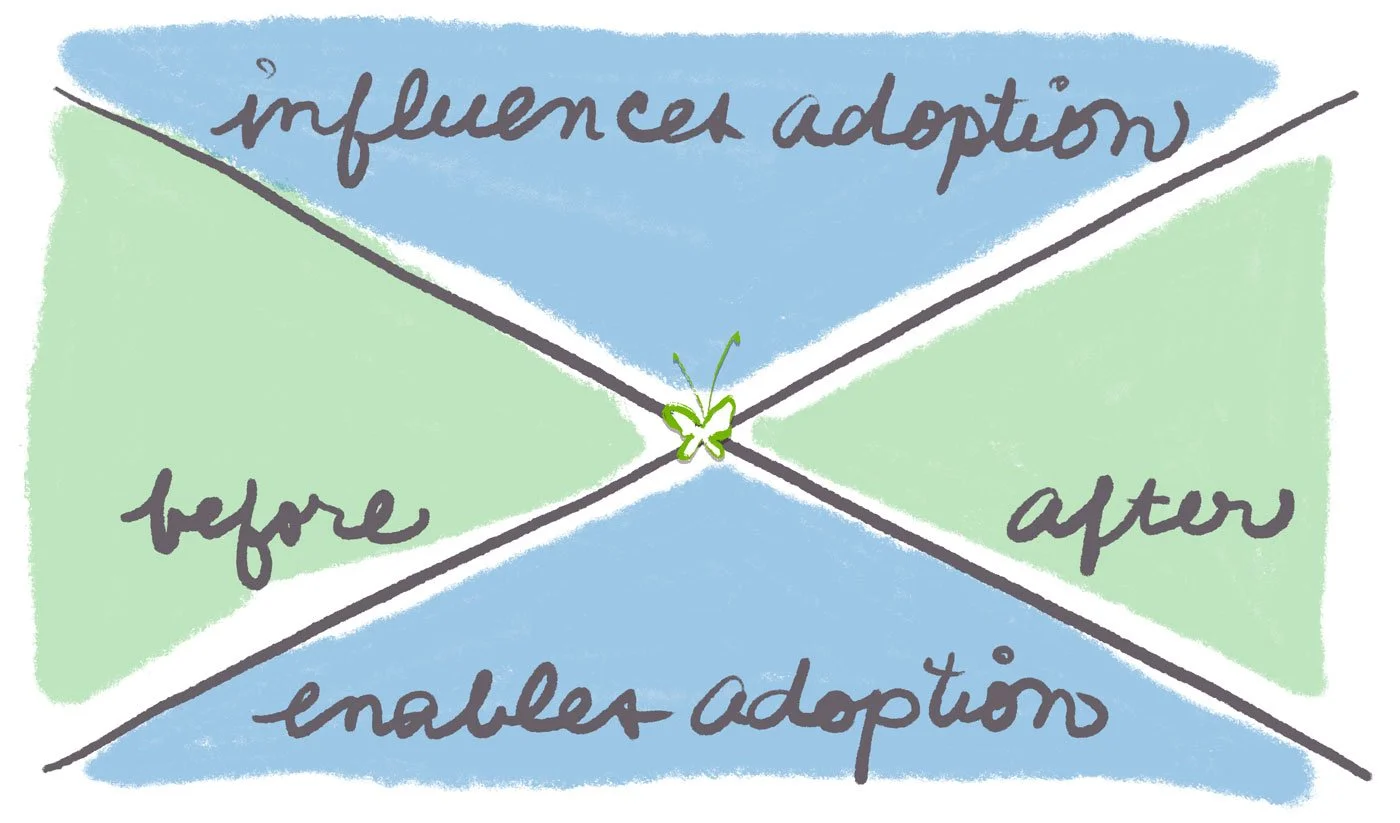
Pretty-fied sketchy version of the basic map (because NDA)
The above grid took a few tries to arrive at. I knew there would be a critical change point at the middle and I sensed that there were converging forces of some kind.
Here is some of the thinking:
Influences adoption
Refers to external big- and small-picture circumstances experienced by our target market that create the need for our solution. It’s what they may be…
Doing now: current habits:
e.g. peak shopping times or traffic times
Using now (or starting to use):
e.g. phones and watches, smart home devices, route mapping, billing cycles and autopay
Worried about now:
e.g. economic uncertainty, climate uncertainty, supply chain glitches
Hopeful about now:
e.g. medical breakthroughs, strengthening communities, declining unemployment rates
Etc.
Enables adoption
These are both internal (our design and communication efforts) and the external circumstances that both clearly solve problems and make the adoption of our product an easy and obvious step. These might include…
Simple, single-screen signup
Further options introduced contextually
Money and time savings
IoT platforms release desired skills
Early aspirational tech adopters lead (and provide feedback)
Before and after
The idea of a before and after is probably self-evident, but note that this perspective is partly inspired by Jared Spool’s many talks on the idea of an experience vision, roughly quoted, “If we do a fantastic job, how will user’s lives be improved?” In other words, what is life like for our audience now, and what will it be like after they’ve adopted our solution?
Here’s a wildly hypothetical example, only a fraction as dense as it should be (these take time—send ideas!), for a self-fueling transportation solution.
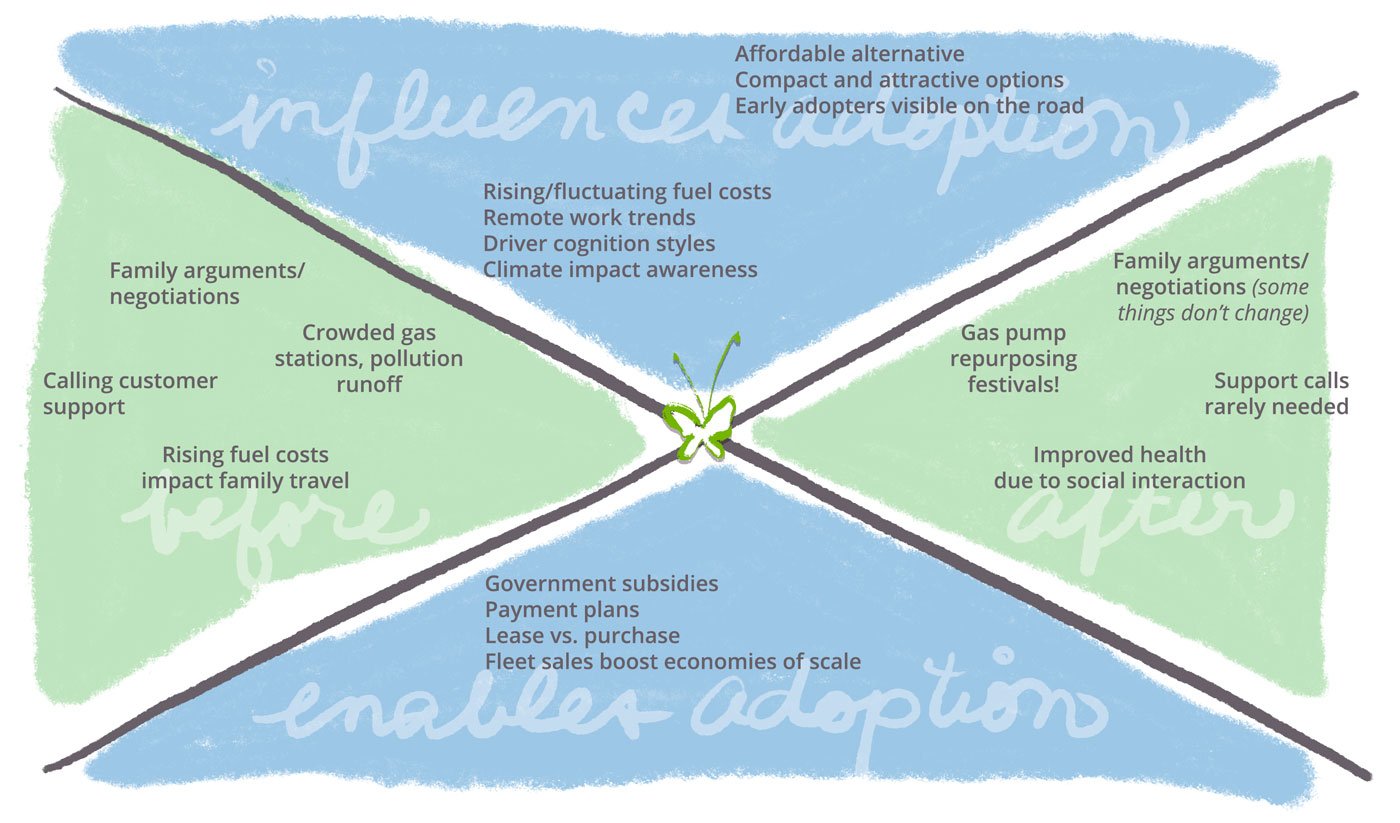
For our project, this exercise proved hugely valuable, not only in clarifying our UX goals, but also in energizing conversations about how to recognize where our solution fits—and can fit—in the world as it is and as it is becoming.