The friction question
I’ve been absorbed with an experiment, an app called Writing Buddy (for now!), and it's an attempt to explore a question that has been nagging me for awhile:
As the machines that assist our thinking get smarter and smarter, how much assistance is too much?
This post focuses on writing and AI, but it’s really about more than writing, and it certainly isn't limited to AI.
Friction is not the enemy
For years, much of software design has been obsessed with removing friction, and that's often the right thing to do. Who misses dial-up modems? or entering the same shipping address over and over? Spell-check, saved passwords, and autofill are all examples of technology removing unnecessary or distracting effort.
Still, I often wrestle with how much friction we should really be removing.
In educational psychology, researchers distinguish between different kinds of cognitive effort. There's a lot of effort that overloads your attention without actually being part of your learning or decision-making. Another type of effort helps build understanding, expertise, and mental models—we need it.
When I think about application design, of course I want to reduce unnecessary cognitive load. What concerns me is the possibility that the productive effort—the germane cognitive load—can be swept away along with it.
Researchers emphasize our need to exert the effort of judgment, choice, and certain types of situational awareness. In writing and other creative pursuits, this is the effort that helps us cultivate practical wisdom as well as our written voice.
In business settings, written reports and communication tend to be repetitive. An original insight tends to be wrapped in a predefined framework that rarely varies. In those situations, it can make sense to encourage AI-generated content. I'm constantly checking workplace usage trends, which are still rising.
What about Grammarly?
Grammarly and other writing assistants solve a real problem. They support, even enforce:
grammar and punctuation correctness
consistency
brevity
All good, but those are not everybody’s goals, and even if they are, maybe not every time. Sometimes writing goals have more to do with things like rhythm, intentional ambiguity, or experimentation, not to mention the frank relatability of so-called street grammar.
Conform an essay or email to the principles of an automated writing assistant and it improves credibility while enhancing readability. But in exchange, there is the danger of losing personality, surprise, even the chance to experience writing that delights a reader and draws them into new ways of thinking.
Again, those tools aren’t wrong. They just serve a particular purpose that isn’t everyone’s particular purpose. With Writing Buddy, I’m thinking about writers with at least some writing confidence, as well as teens and young adults in high school and college. Writers of professional articles or insights, essays, academic papers, even poems, or stories.
I like the way I write. (Most of) my grammar foibles are intentional. I also wonder about the writers I admire. How often do they ignore a grammar bot? Would they have become the writers they are if a bot had corrected every awkward sentence they ever wrote?
I don't know the answers to questions like these, but I think we should ask them.
What should AI-powered applications optimize for?
Far beyond writing, AI gives us a whole new level of capabilities.
It can do things like personalize experiences at an individual level, access enormous amounts of information almost instantly, adapt its behavior based on context, incorporate evolving research, and update itself over time.
With profound capabilities like these, why do so many applications seem to be using the new tools only to pursue familiar objectives?
faster output
greater efficiency
increased engagement
higher conversion
more retention
These are good, important objectives. At the same time, while we've become very sophisticated at tracking and improving commercial outcomes, I would suggest we're oddly unsophisticated when it comes to the human outcomes that have made us the resilient innovators and creators we are.
Those are harder (but not impossible) to track and improve. As a result, we end up focusing on what we’re used to. I wonder whether we're thinking way too small. Imagine using a large hadron collider to crack open a walnut.
Optimize customer reach, smooth workplace processes and business services—absolutely, yes.
But why aren't we aiming higher?
What AI Can Do
This list represents some of the assistance I welcome in the AI tools I have.
adapt feedback to experience level
spot recurring patterns
act as a logic checker
point out unsupported claims
identify and summarize credible research sources
show me where my ideas are already being covered
show me varying perspectives or approaches
We can already tune GenAI to work with us this way, but it's not the default. What if we created an interface to assist a writer—whether a knowledge worker, student, or creative writer—within a spectrum of activities that support, even cultivate, what some are calling our “cognitive muscles”?
I’d love a trusted assistant that knows the literary devices I lean on too heavily, notices when my argument takes a leap that only makes sense inside my own head, and can role-play a reading audience, such as peer, potential employer, or one of my writing heroes.
What AI can’t do
AI cannot develop my voice for me, decide what matters to me, or discover what I believe as those values evolve. It can’t decide which metaphor matches my emotional intent or replace my messy, accumulating lived experience. Ultimately, it can’t do the actual work of being a writer, where the most central—and sometimes the toughest—thinking and decision-making remains mine.
With this in mind, the design challenge becomes figuring out how AI can support the writer while staying out of the way of the process.
The Experiment
I’d been mulling the idea for awhile, but a conversation with an English professor eventually pushed me toward building the Writing Buddy concept. The project has become an exploration more than a product:
What if the goal of a writing tool isn't simply generating text, but helping a person become a stronger writer? a better thinker?
In its current state (a simple prototype based on vibe-coded versions), the concept is rife with assumptions that need testing. The process has raised some good questions, and now, as a prototype, the conversation can be a bit more concrete, allowing us to point to an interface and ask whether the choices get us where we want to go.
I should add that the writers I’m targeting here are not AI power users. They ask ChatGPT or Claude plain-language questions and haven’t delved deeply, if at all, into prompting as a skill.
Compact walkthrough
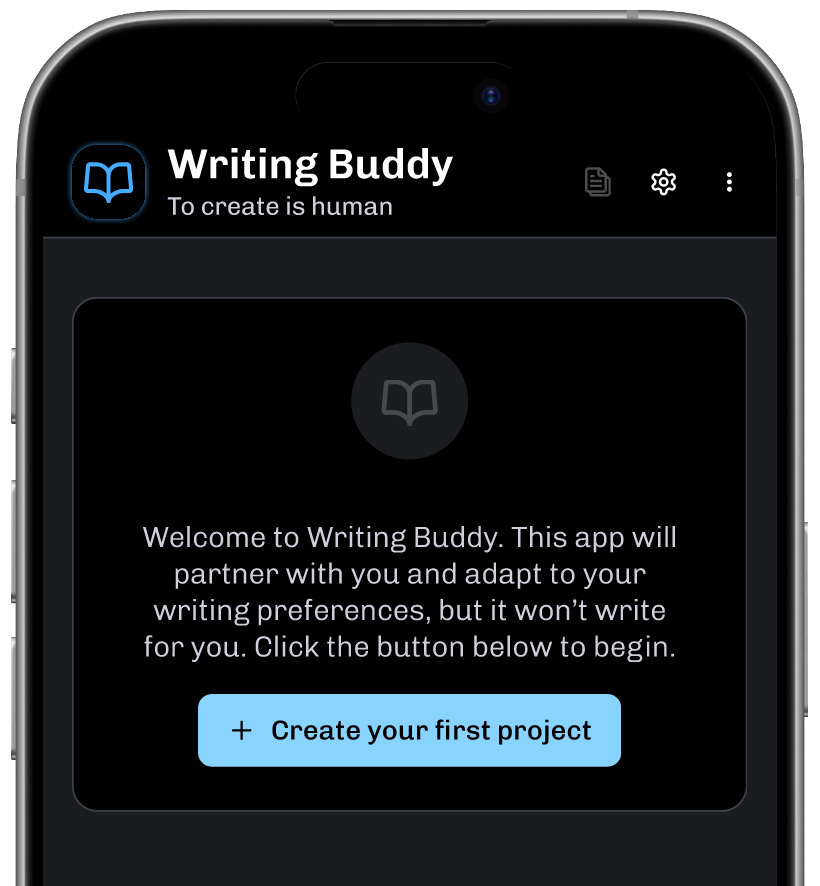
Writing Buddy welcome screen
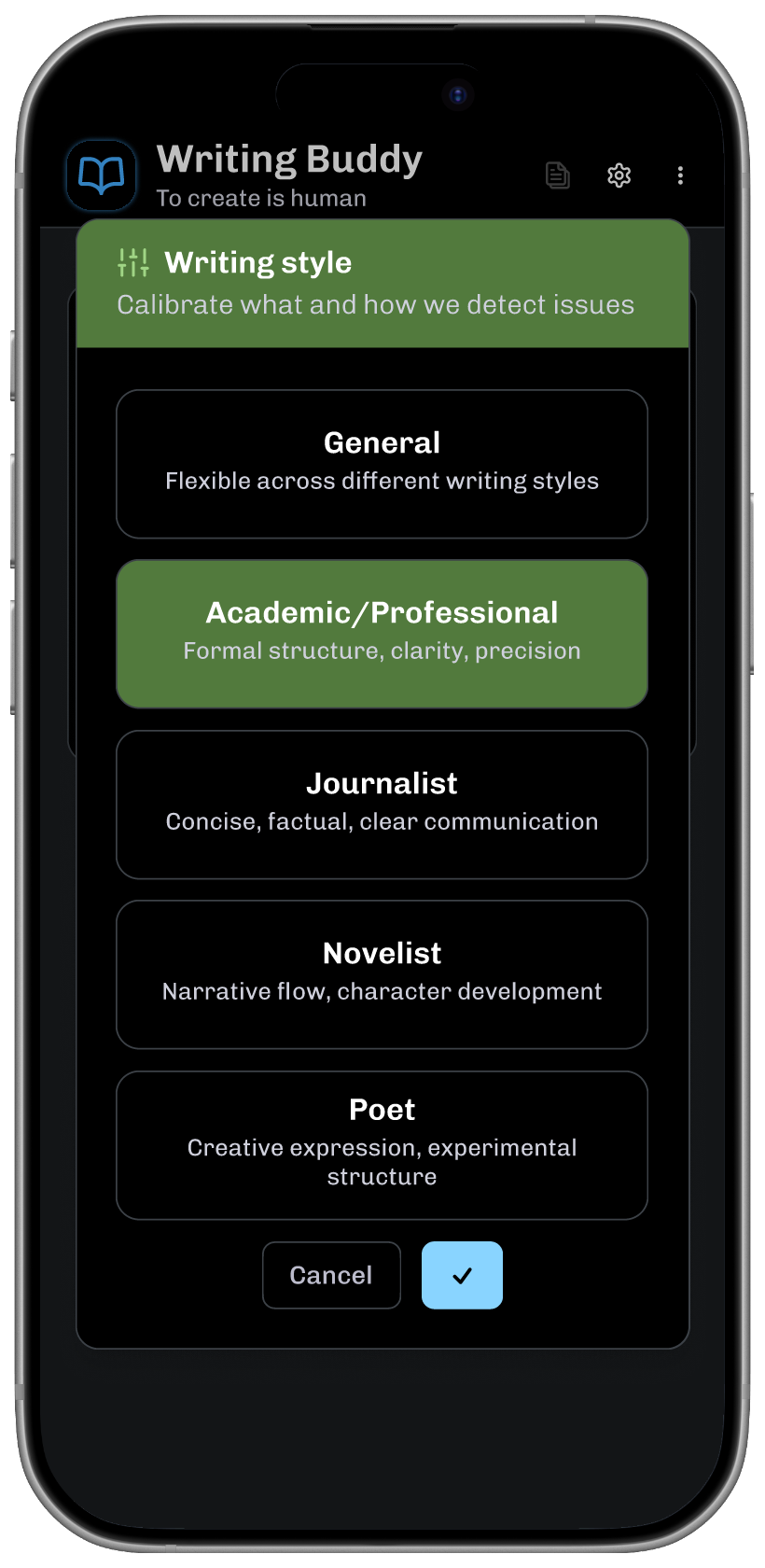
Setting the writing style indicates the type of feedback desired.
This is a preliminary set of writing styles the app would adapt to. I’ve also been thinking about a fully customizable writing type that would become available to a writer who has become familiar with the app, as well as a way to toggle on/off red underlines to catch spelling errors inline.
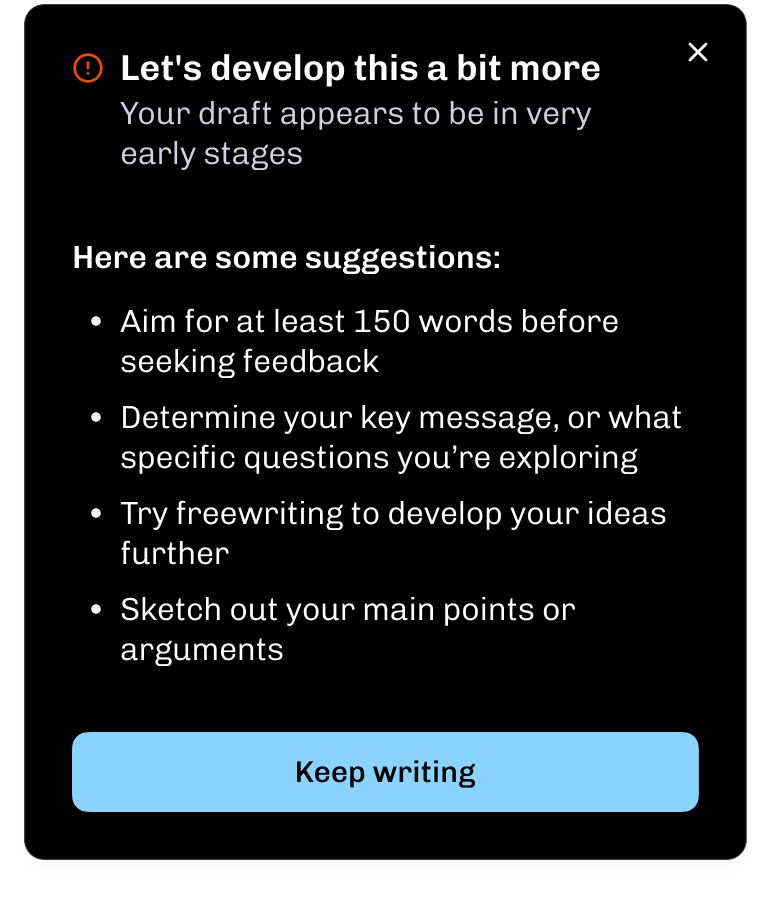
When a writer asks for feedback prematurely
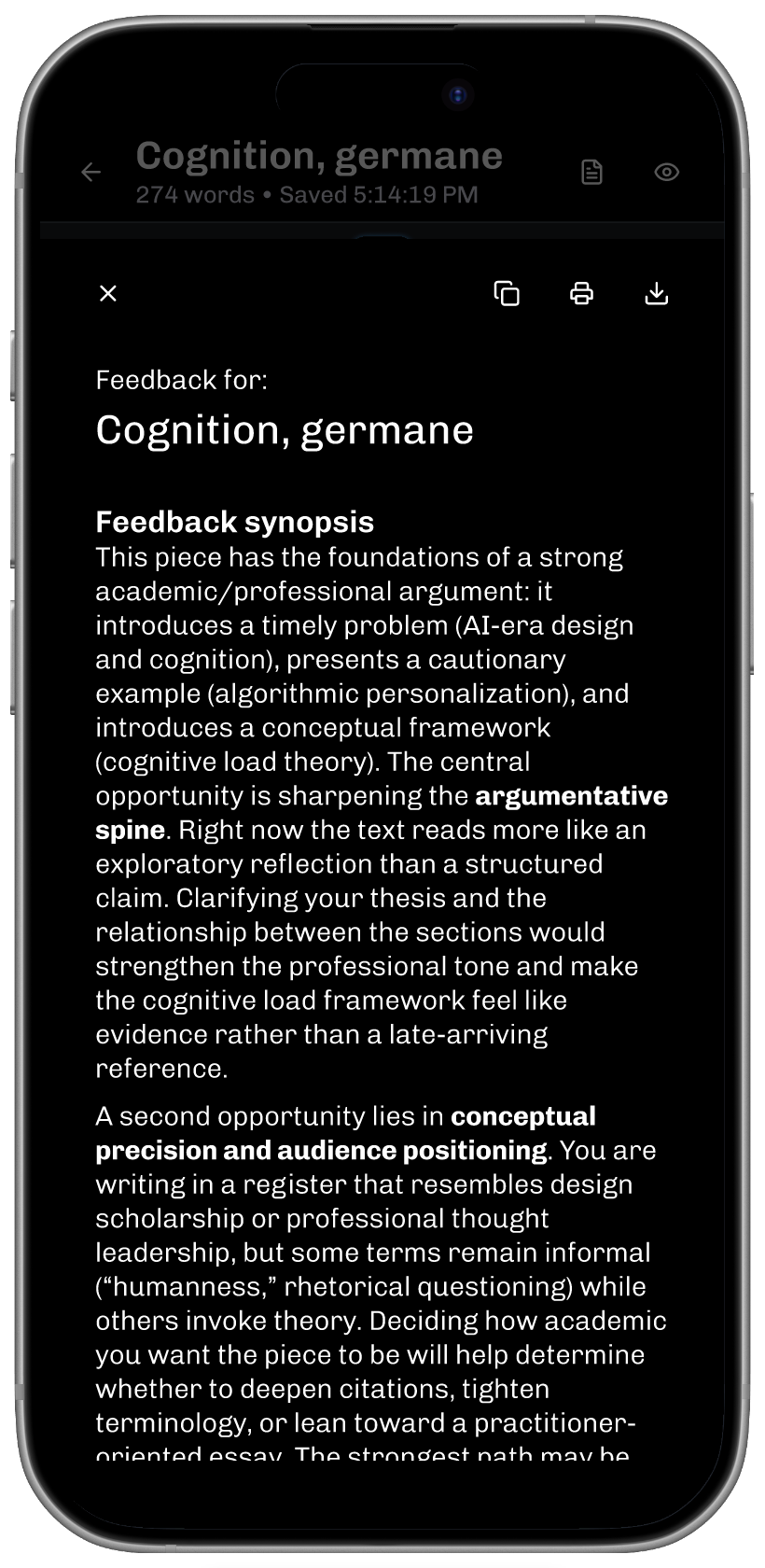
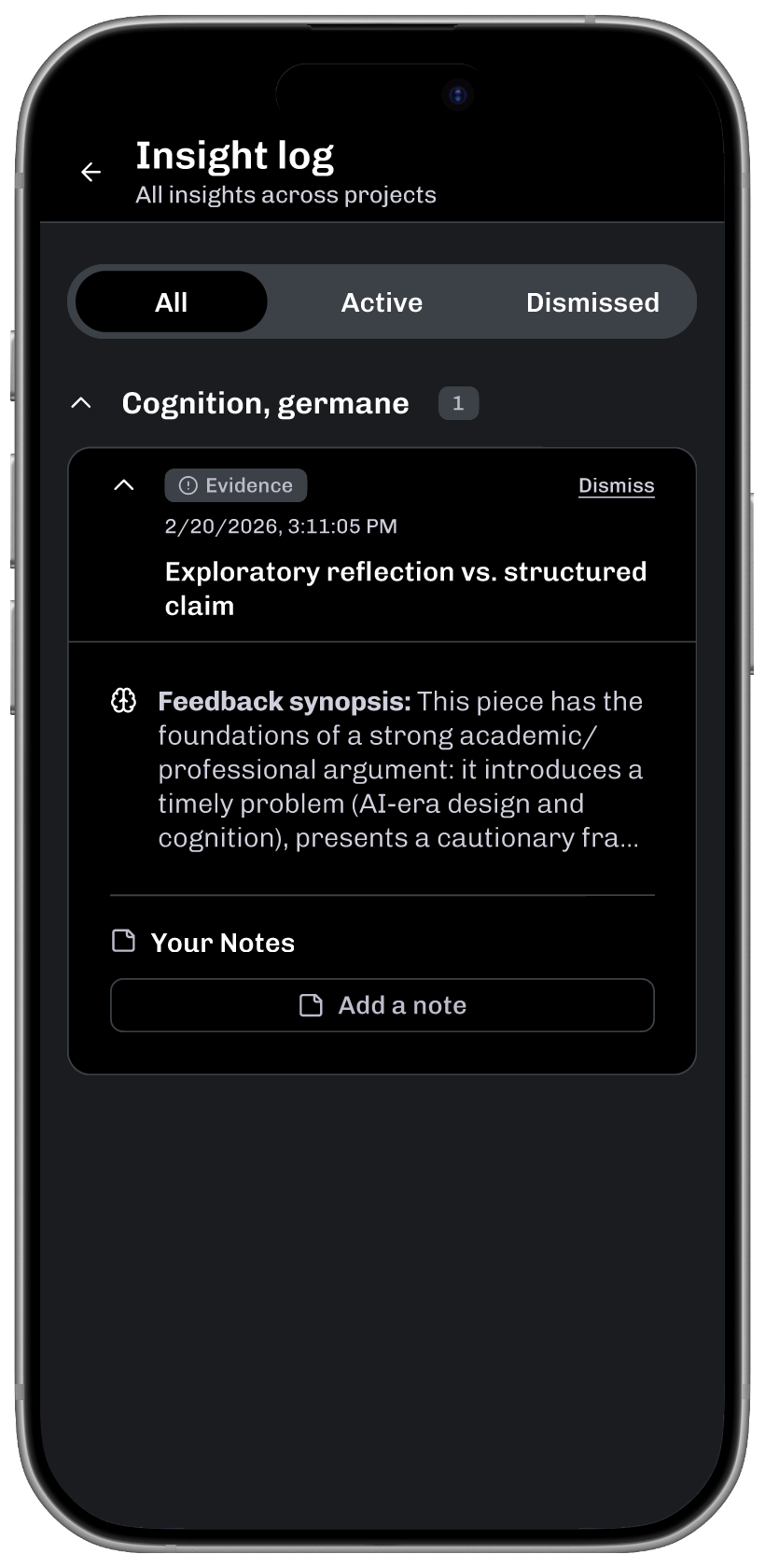
The intention is always that ultimate judgment is in the hands of the writer. The app’s critiques can be completely ignored, even dismissed. And critique isn’t presented as markup over the article, but lives out of the way in an Insight log.
This prototype is intentionally lightweight. Its primary aim is to spark conversation. Depending on available time and resources, it can either progress or do no more than feed into the stream of like-minded thinking.
Next time I get a window, there are a number of updates I’d like to make. I’ll post those in a separate article.
If you'd like to see the prototype, feel free to contact me.
Research needed
An interesting discovery from this project is how little certainty I have about success metrics. In addition to defining any of the more traditional business metrics, what would the human metrics be? Confidence? Development of voice? Something fully customizable? Do we even need them?
If AI can hyper-personalize an experience, then not only do we have the capacity to customize for and serve a greater breadth of values and perspectives, but we can also, with permission, capture and benefit from that greater breadth.
And even as we gather insights through increasingly sophisticated analytics, this is also where I believe in-person UX research becomes essential. We can’t visit or interview everyone, but we can discover voices we’ve been missing up to now, and begin to learn from them.
In the context of writing, this would mean observing writers writing, interviewing them, seeing where they struggle, and beginning to understand what kinds of assistance feel supportive vs intrusive.
I also suspect there's a community component hiding somewhere in the app. AI can transform the experience for different types of writing goals, but I doubt it eliminates the need for human perspectives.
Questions
As an evolving experiment (which includes the process of writing this post), at least as much as a product, so many questions have already been raised.
What kinds of assistance genuinely help us grow, both in craft and in capacity to innovate?
How should AI-powered applications balance efficiency with that capacity?
If AI can adapt to individuals in ways previous software never could, what else can we ask of it?
Am I asking the right questions?
Are we asking the right questions?
Thankfully, I’m not the only one exploring these ideas. See the Further reading links below.
Further reading
NOTE: More recent studies will mean findings are early amid rapidly changing literature.
Papers and articles
Experimental Evidence on the Learning Impact of Generative AI (2026)
Note: This study found learning benefits overall, particularly when students used AI for explanation rather than text generation.
Caveats: Participants come from one selective college, types of assistance tested were not consistent, some data was self-reported.
Generative AI without guardrails can harm learning: Evidence from high school mathematics (2025)
Caveat: Unclear whether the results with guardrails in place came from friction, answer withholding, instructional design, etc.
The Impact of Generative AI on Critical Thinking: Self-Reported Reductions in Cognitive Effort and Confidence Effects From a Survey of Knowledge Workers (2025)
Caveats: Based on self-reporting, though the surveys used are rigorous.
Accompanying blog post: Rethinking AI in Knowledge Work: From Assistant to Tool for Thought
“If we allow AI to think for us, we risk hollowing out the very skills that make progress possible.”
Your Brain on ChatGPT: Accumulation of Cognitive Debt when Using an AI Assistant for Essay Writing Task (2025)
Caveats: Small sample (54), contested. See “Generative AI without guardrails…” paper above.
Brain Drain: The Mere Presence of One’s Own Smartphone Reduces Available Cognitive Capacity (2017)
Caveats: Highly cited, but replication is mixed, with later studies suggesting other possible influences.
Other resources
Advancing Humans with AI (AHA)
“A multi-faculty research program that investigates the human experience of pervasive AI with the goal of designing human-AI interactions that promote human flourishing.”
AI Wrapped 2025 (an AHA project)
“A personalized journey through your year in AI conversations, revealing how you've used AI tools, what you've explored, and the patterns that define your digital partnership.”
Google Research: People + AI Research (PAIR)
“A multidisciplinary team at Google that explores the human side of AI by doing fundamental research, building tools, creating design frameworks, and working with diverse communities.”
Masakhane
An African-language AI research community. Tangentially, rather than directly relevant, since the focus is not on cognition, but important to know about: Its members build open datasets, translation systems and language models while insisting that local communities determine what represents them and how their data is used.
Microsoft Research Cambridge: People-centric AI
“Develops knowledge, model capabilities, and experiences that enable human agency and skill, support creativity and collaboration, and ensure equitable representation and participation.”